

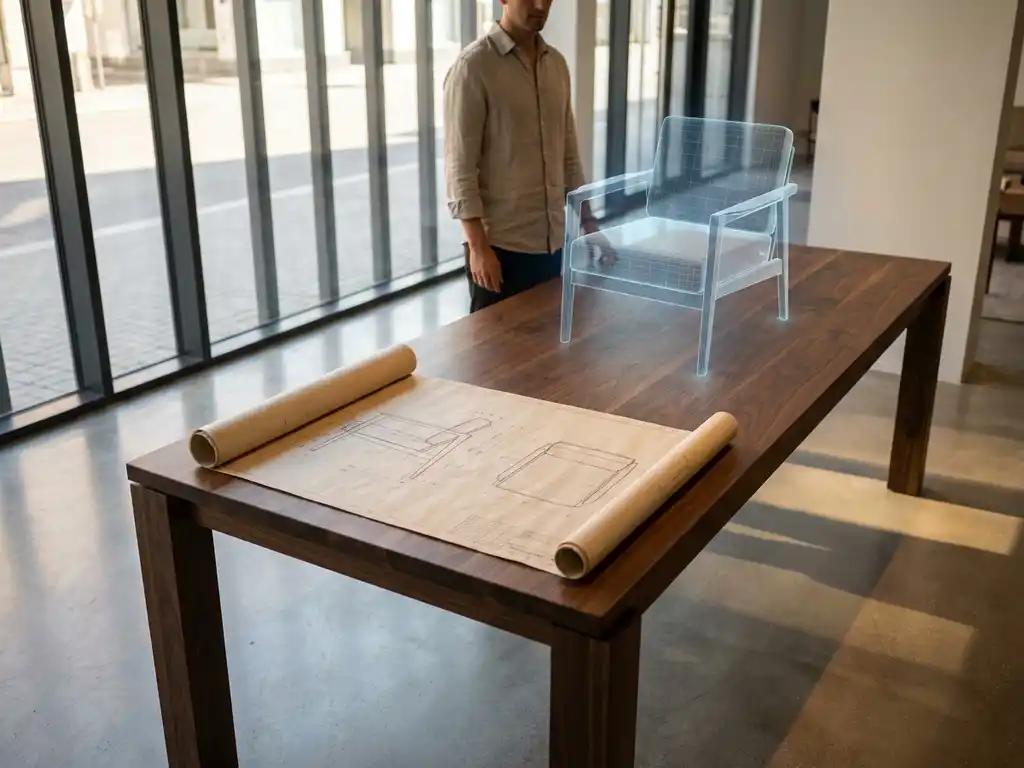
The main difference between 2D and 3D furniture visualizers lies in dimensional depth and interactivity. 2D visualizers display flat, static images of furniture from fixed angles, while 3D visualizers create interactive, three-dimensional models that customers can rotate, zoom, and view from any angle. 3D solutions also enable real-time customization, room planning software integration, and augmented reality experiences that 2D cannot provide.
What is the difference between 2D and 3D furniture visualizers?
2D furniture visualizers display products as flat images or illustrations from predetermined angles, while 3D visualizers create interactive three-dimensional models that customers can manipulate in real-time. The key difference is interactivity and depth perception.
2D visualizers work like enhanced product catalogs, showing furniture through photographs, technical drawings, or flat renderings. Customers see the product from whatever angles the manufacturer photographed, typically front, side, and three-quarter views. These images remain static regardless of customer interaction.
3D visualizers generate interactive models that customers can rotate 360 degrees, zoom in on details, and view from any perspective. Advanced 3D systems also allow real-time customization of colors, materials, and configurations while maintaining photorealistic quality throughout the interaction.
How do 3D furniture visualizers work compared to traditional 2D methods?
3D furniture visualizers use computer-generated models and rendering engines to create interactive product experiences, while 2D methods rely on static photography and image editing. 3D systems build mathematical representations of furniture that can be manipulated in real-time.
Traditional 2D methods require extensive photography sessions for each product variant. Manufacturers must photograph every color, fabric, and size combination separately, creating hundreds or thousands of individual images. Any product changes necessitate new photo shoots, making updates slow and expensive.
3D visualizers start with digital product models that contain all possible configurations within a single file. When customers select different options, the software instantly renders the new appearance without requiring separate assets. This approach scales efficiently across unlimited product variations while maintaining consistent visual quality.
What are the main advantages of 3D over 2D furniture visualization?
3D furniture visualization offers superior customer engagement, unlimited product variations, integrated room planning capabilities, and significantly lower long-term content costs compared to 2D methods. These advantages directly translate to higher conversion rates and reduced returns.
The interactive nature of 3D visualization keeps customers engaged longer on product pages. Instead of scrolling through static images, customers actively explore products, building an emotional connection and purchase confidence. This engagement typically results in higher conversion rates and larger order values.
3D systems excel at showing product variations instantly. A single 3D model can display thousands of color, material, and size combinations without requiring separate photography for each option. This capability becomes essential for businesses offering highly customizable furniture where traditional photography would be prohibitively expensive.
Advanced 3D visualizers integrate room planning software that allows customers to place furniture in virtual spaces, experiment with layouts, and coordinate multiple purchases. This functionality addresses the primary challenge in furniture buying: understanding how products will look and fit in the customer’s actual space.
When should furniture businesses choose 2D vs 3D visualizers?
Furniture businesses should choose 3D visualizers when selling customizable products, targeting higher-value purchases, or requiring room planning functionality. 2D remains suitable only for simple, non-customizable products with limited variants and tight budget constraints.
3D visualization becomes essential for businesses offering configurable furniture with multiple material, color, or size options. The cost of photographing every possible combination quickly exceeds 3D development costs, while 3D provides unlimited variations from a single model. Companies selling modular furniture, custom upholstery, or build-to-order products particularly benefit from 3D capabilities.
2D methods might suffice for businesses selling simple, standardized furniture with minimal customization options. If your catalog contains fewer than 50 products with limited variants, and customers don’t need to visualize products in room contexts, 2D photography may meet basic requirements while maintaining lower upfront costs.
How much more expensive are 3D furniture visualizers than 2D solutions?
3D furniture visualizers typically cost 2-5 times more than basic 2D solutions initially, but become more cost-effective long-term due to reduced photography needs and unlimited product variations. The break-even point usually occurs within 12-18 months for businesses with extensive product catalogs.
Initial 3D development requires creating digital models, setting up rendering systems, and integrating interactive features. This upfront investment ranges from moderate to significant depending on catalog complexity and desired functionality. However, 3D systems eliminate ongoing photography costs that accumulate quickly with traditional 2D approaches.
2D solutions appear cheaper initially because they primarily involve photography and basic web integration. However, costs compound rapidly as businesses expand product lines or update existing items. Each new product variant requires additional photo shoots, while 3D systems handle new variations through software updates at minimal incremental cost.
How iONE360 helps with furniture visualization
We provide comprehensive 3D furniture visualization solutions that eliminate the limitations of traditional 2D methods while delivering measurable business results. Our platform combines advanced product configuration with integrated room planning capabilities, enabling furniture businesses to showcase unlimited product variations and create immersive customer experiences.
Key benefits of our 3D visualization platform include:
- Automatic generation of photorealistic product images for all possible configurations
- Integrated space planning tools that let customers design complete room layouts
- Seamless integration with existing business systems and e-commerce platforms
- Reduced photography costs and faster time-to-market for new products
- Higher conversion rates and lower return rates through improved customer confidence
Ready to transform your furniture visualization strategy? Explore our showcases to see 3D visualization in action, or contact us to discuss how our platform can address your specific visualization needs and drive measurable improvements in customer engagement and sales performance.
Frequently Asked Questions
How long does it typically take to implement 3D furniture visualization on an existing website?
Implementation timelines vary based on catalog size and complexity, but most businesses can launch 3D visualization within 4-8 weeks. This includes creating initial 3D models, integrating the platform with your e-commerce system, and training your team on the new tools.
Can 3D furniture visualizers handle complex materials like fabrics and wood grains accurately?
Yes, modern 3D visualizers excel at rendering complex materials with photorealistic accuracy. Advanced systems can simulate fabric textures, wood grain patterns, leather finishes, and even reflective surfaces like glass and metal, maintaining visual fidelity across all product variations.
What happens to my existing product photography investment when switching to 3D visualization?
Your existing photography can serve as reference material for creating accurate 3D models and textures. Many businesses use a hybrid approach initially, gradually replacing 2D images with 3D models as they expand their digital catalog, maximizing their previous photography investment.
Do customers actually use room planning features, or do they just view individual products?
Studies show that customers who engage with room planning features have 40-60% higher conversion rates and spend significantly more per order. The ability to visualize furniture in context addresses the primary purchase barrier in furniture buying and leads to more confident purchasing decisions.
How do I measure the ROI of upgrading from 2D to 3D furniture visualization?
Track key metrics including conversion rate improvements, average order value increases, return rate reductions, and photography cost savings. Most businesses see measurable improvements within 3-6 months, with full ROI typically achieved within 12-18 months through increased sales and reduced operational costs.
What technical requirements do customers need to view 3D furniture visualizations?
Modern 3D visualizers work on standard web browsers without requiring special software or plugins. They’re optimized for both desktop and mobile devices, ensuring customers can access 3D experiences regardless of their device or technical expertise.
Can 3D visualization integrate with my existing inventory management and pricing systems?
Yes, professional 3D visualization platforms offer API integrations with major e-commerce platforms, ERP systems, and inventory management tools. This ensures real-time synchronization of product availability, pricing, and specifications across all customer touchpoints.