

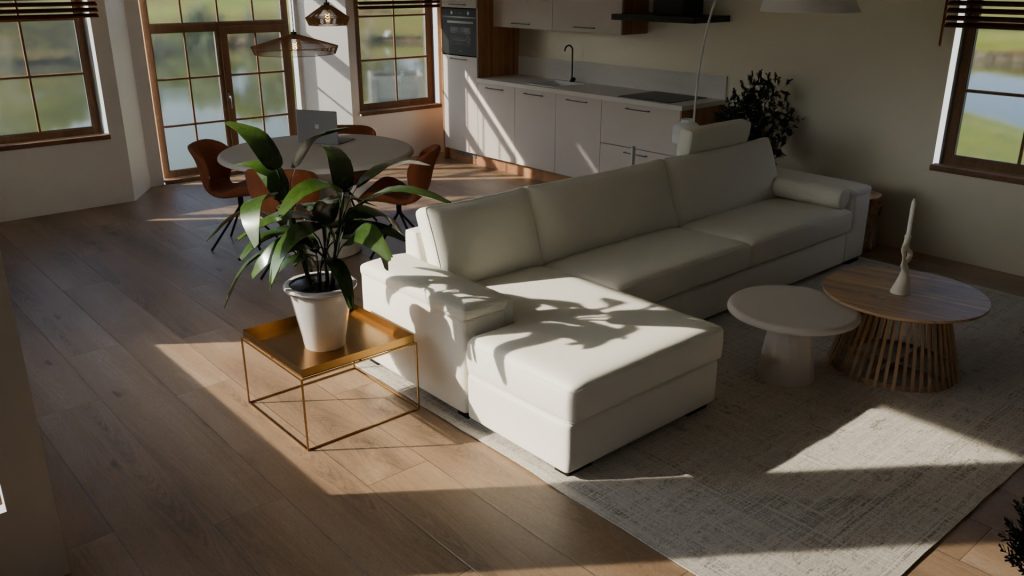
Render created with HomeDecoHub
When people are considering big-ticket furniture items, like sofas and dining sets, moving them from browser to buyer requires a leap of faith. That’s usually because people struggle to visualize how the final, configured product will look in their home.
Product configurators and room planning tools like iONE360 and HomeDecoHub help to alleviate most of the buyer’s doubts, as we explore in our article on ‘configuring confidence’. But the real game changer for furniture retailers is the ability to give people photorealistic 3D images at the point of sale (POS). Making that move can truly help to lift retail sales.
What are photorealistic 3D POS solutions?
Photorealistic 3D POS solutions present configurable products that look indistinguishable from real-life photography. Photorealistic 3D takes traditional product visualization to the next level. Instead of showing shoppers a generic 3D model or a static lifestyle image, these solutions show all the tiny details that matter: such as how fabrics have texture and leather naturally reflects light.
At the heart of this experience is a product configurator. Shoppers and sales associates use it to change layouts, materials, finishes, and options; generating instantly updated, photo-quality 3D images. This realism directly supports how people make decisions in store.
“Selling starts with seeing. The more realistically you can show a product, the more doubts you take away from the customer,” says David Colijn, Product Owner at iONE360.
This matters to furniture retailers because buying decisions are complex. A sofa is never just a sofa. It’s a size, a fabric, a color, a configuration, and a commitment. Photorealistic 3D POS solutions make those choices clear when they matter the most.
Why photorealism outperforms standard visualization
Standard visualizations help explain options, but they still leave space for uncertainty. Customers may understand what they’re selecting, yet still wonder how it will actually look. Photorealistic 3D solutions close that gap by offering a perfect preview of the final product.
In store, this creates two major advantages. First, it accelerates conversations between sales teams and customers. Instead of walking back and forth between displays, fabric swatches, and different departments, everything happens in one place, on one screen.
Second, it introduces self-service. Touch screens placed next to physical products allow customers to explore configurations on their own, even before engaging a sales associate.
This efficiency is critical for modern retail. Fewer staff can support more shoppers without sacrificing the customer experience. At the same time, customers feel more confident because they are seeing exactly what they will receive.
How does photorealism drive more furniture sales?
Confidence drives conversion. When customers instantly see a sofa in their chosen fabric or compare colors side by side, hesitation fades. Decisions happen faster and there are fewer objections. That confidence also opens the door to higher-value sales.
Photorealistic POS solutions also reduce showroom fatigue. Walking back and forth between floors or different departments breaks momentum and causes doubt to creep back in. Keeping the experience focused and visual helps maintain emotional engagement from start to finish.
Once a shopper trusts what they see, they’re more open to recommendations. This is where visualization becomes a sales multiplier. Instead of selling a single item, retailers can begin showing how products work together. A sofa naturally leads to a rug, a coffee table, or a recliner that complements it.
On top of that, once you’ve configured a ‘hero’ item like a sofa, the natural next step is to place that configured product into a complete space. A digital room planner leverages the same visual confidence and applies it to the bigger picture, helping customers see not just a product, but a finished home. That’s where configuration and room planning truly come together in the shape of iONE360 and HomeDecoHub.
Learn more about the powerful synergy of product configurations and digital room planning tools in our blog about configuring confidence.
